Search This Blog

Showing posts with label Yunnan. Show all posts

Tuesday 11 December Contd.

Jade Water Village sign with
animistic symbols
So much happened on this day that I had to split it into 2 posts. Following the Lijiang Experience we went to the Jade Water Village or Yushuizhai, about 15kms from Lijiang. This is basically a tourist attraction, the concept of a Naxi man, He Changhong, awhich was completed in 2005 and is built on a Dongba holy place. The spring from which it gets its name originates from melting snows that travels underground for about 2,400 meters before emerging at the Jade Water Village.

No Smoking - carved in stone
The use of stone, and stone carving is common in China, and many signs are made in stone. Jade Water Village was no exception, so the entry sign, with its animistic motifs and the no-smoking sign (among others) were in stone.

I’ve found smoking to be much less prevalent than I expected in China (very few staff or students in college smoke) and it seems only the usual die-hards that smoke anywhere – lifts, restaurants, etc. That also applies to spitting on the ground/floor, which although not too prevalent, is common enough to cause being wary when walking. There definitely is a strong non-smoking awareness here, although it may be different in rural areas and the big cities.
The magnificent golden
statue dedicated to nature

The golden statue and spring
The village itself is dominated by a huge golden statue with a human head and torso but lower body of a snake, where the spring emerges. There are many other similar bronze sculptures with animistic themes near the spring and surrounding the temple. 

These are meant to portray the Naxi belief in “the god of nature” and the need to live in harmony with the environment and nature. To quote a powerful prayer verbatim from a stone inscription:
Confession
To the ultimate awful spirit of nature:
The nature, who predominated by almighty you, we are brothers!
We had been punished by ignoring the natural rules constituted by you;
We have incurred the mud-rock flow because of destroying the forests, exploiting sand and rock illegally;
We have incurred sand storm because of demolishing the vegetation and grazing to excess;
We have endured the extinction of creatural species because of wanton slaughter;
We have incurred the extinction of the botanic species because of overuse;
We have infected by the plague because we discarded the garbage anywhere;
We have let the water polluted because we discharged foul water at will;
We have let the air polluted because we emitted exhaust gas without restraint;
We poisoned our food because we overused the growth hormone and pesticide;
Please forgive our sins!
We have been punished by what we have done, you have warned us. We therefore devoted to protect and beautify the environment we live, and we will try our best to pay back what we have owed you.
We beg you the forgiveness.
Blessing!

Temple with animistic statues in the
 forground
The animistic statues detailed
I was particularly impressed by the statues, all designed by Cunfabio from Heqing. There were 10 similar statues,  at the spring depicting a seahorse, frog, bear (?) and eagle, and at the foot of the temple, a deer, boar, rhinoceros, elephant, lion and monkey.

Each one was completely different, with its own individual expression, and gesture and torso. The village has many other features focusing on Naxi and Dongba culture including highly detailed murals. A central feature was a series of crystal clear ponds with salmon and trout (I think). For me, it was absolutely one of the highlights of the trip.


Village map and advisory sign
Entrance to the Tea-Horse
Road Museum
Village map and advisory sign - "Don t forget to keep civilized behaviour during an outing, and also shopping should be rational"

The rest of the afternoon we spent in another ancient village near Lijiang, possibly a little less frequented by tourists than the village closer to the city. To my surprise, after wandering down a small alley I discovered the Ancient Tea-Horse Road Musem.

The museum was distributed across a large complex of separate buildings, each one featuring an aspect of Naxi life, culture or industry. The two most interesting buildings dealt with leather production, and the history of the Tea-Horse Road.

The Tea-Horse Road was a trade route to the west, formed mainly as a result when the Tang stopped trade to the east because of conflict between them and the Tubo people from the north who had expanded into Naxi territory. There is an informative subtitled 8 part series on the Tea-Horse Road on the Chinese CCTV website.

Painted door panel, and a dog
catching the last rays of the
afternoon sun
A New 'ancient' building being
constructed
Also interesting to me, as an ex Heritage Office person, was the way in which new buildings in the old town were being built with the traditional materials and methods of the past.

It reminded me of the practices we’d seen in Europe and Japan, where if a historic building is destroyed, it is rebuilt based on old plans and local knowledge using the same materials and methods where possible.

With timber structures and their susceptibility to fire this is almost necessary. It may not be the prefect solution, but does maintain a visual and physical connection with the past.

One of the quaint stone
buildings
Discussing the price of safron
Meanwhile, Frances, Cahrlotte and Rocky were enjoying their last shopping opportunity in Yunnan, buying gifts for friends and interesting articles for themselves.

Frances bought some safron (sold in bulk) and some of the compressed tea, the way it was traditionally packaged for overland transport by horse – not the loose leaves that we are used to. 

The tea selection here is pretty amazing – everything from fresh green tips to dark black, and the compressed packages. The store itself was packed with herbs, teas and almost any local dried plant product that you can imagine.

 Rocky bought some quite expensive yak meat (preserved with honey and sesame seeds and quite chewy) for her family. Much to her horror, she later left it at the airport in Lijiang on our departure for Hangzhou and return to the east.

Tuesday 11 December

At 3,356m base camp
Ascending in the cable car, passing
the tree-line
Today was probably the highlight of the Yunnan trip for me. The main activity was the ascent of the Yolong (Jade Dragon) snow-capped mountain, visible form Li Jiang itself.

It was only a short 30 min bus ride to the base, where we caught shuttle buses to a base part-way up the mountain, an altitude of 3,356m. From here we caugh a  cable car for the next part of the ascent to another landing at 4,506m. This ride up was spectacular, especially amazing as we passed the tree-line and landed above the clouds. To the right of the landing was the small glacier, the first we’ve seen.

Qianxi Oxygen and Coat Rental Shop
At the 4,506m landing, the view was
spectacular
At this point we could feel the lack on oxygen. Just walking around required a slight effort.

After spending a little time taking photos and checking the oxygen bottles we’d purchased the day before we began the ascent up the wooden walkway.

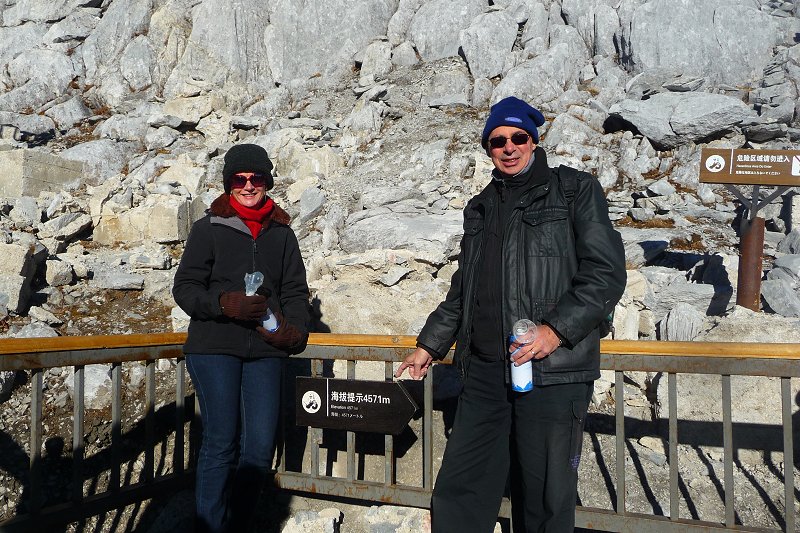
Climbing up was a surprisingly hard effort but the view from above the clouds was spectacular. We had been a bit cynical about the need for oxygen, but once we started climbing the steps that attitude dissipated and we started using the oxygen to help us breathe.

Pausing for a breather at 4,571 metres
Looking down at the chair lift landing
from 4,576 metres
Were were glad we’d had an early start as we could see that the clouds were starting to roll in below us, screening out the view of the valley below.

Frances and I stopped at 4,576 metres, concerned that we would be too late to catch the return bus. Charlotte and Rocky continued to the top of the pathway at 4,680 metres - so we did have time to continue!

It’s hard to describe the feeling of being at that altitude, and looking down on the world below – every metre counts as each step upward became an effort! It was with real reluctance that we headed back down the mountain.


Beginning of the "Lijiang Impressions"
performance
Part of the performance on horseback
Following our descent from Yolong mountain we were scheduled to view a local performance - we had no idea what to expect.

Before the show, we had what was probably the worst meal we’d had during the trip. The fact that we were one of the last customers at the eatery probably didn’t help. The food was edible, but the conditions were disgusting after hundreds of people had eaten and left their unfinished food and trays everywhere.

A short time later we were ushered into a massive arena/amphitheatre, with a backdrop of Yolong mountain. Within a short time, the stage area was filled with music and performers, men and women in costume.

Quoting from the brochure:
 Lijiang Impressions is a cultural show demonstrating the traditions and lifestyle of local Naxi, Yi and Bai ethnic minorities. The show is staged right under the famous Jade Dragon Snow Mountain, which makes it the highest natural performance field in the world at 3,100 meters. It is also the second outdoor production for famous Chinese film director Zhang Yimou after his first show called “Liu Sanjie Impressions” in Yangshuo, Guilin Province.

Full cast in part of the finale sequence
The show is apparently involves 500 local people from ten different ethnic groups who were selected from 16 towns and villages in Lijiang. They use original native songs, dances and music to display the harmony of nature and human souls.

To describe the performance as impressive would be an understatement. It was a tightly choreographed exhibition of Naxi, Yi and Bai ethnic culture, woven into a loose storyline accompanied by fantastic music and singing. 

An enthusiastic westerner buys a copy
of the DVD
It was quite obviously a manufactured event, but nonetheless we couldn’t help being overwhelmed by the performance.

Of course we are getting a highly produced version of the cultures, however because the production does employ Naxi, Yi and Bai people and pays tribute to their cultures, I think that overall it has a positive effect.

And of the hundreds of people in the audience, I saw no other westerners. Speaking of the audience, I was quite surprised to see people going onto the stage during the finale to be photographed in front of the performers – something that wouldn’t happen in Australia.


Composite video of some of the "Lijiang Impressions" performance.


Monday 10 December

Entrance to Patatso National Park
The park during the four seasons
The main destination today was Potatso National Park and the Bita Lake Nature Reserve about 22kms from Shangri La.

It was the the first national park in China to meet International Union for Conservation of Nature standards. The park  has two lakes, a visitor center, several interesting minority villages, lush forests and pasture views.

Bita Lake
Entrance to Bita Lake
From the visitor center a park bus takes visitors 13 km to the first stop,  Shudu Lake which was very picturesque, and almost wherever I pointed the camera I could take  a picture postcard photograph.

The information centre had information panels of the lake in the four main seasons, unfortunately autumn (when we were here) is  probably the least interesting. The weather was cold, dry and there was no green pasture (a feature of summer) or wildflowers (a feature of spring). The natural beauty though was still apparent – and the first pure blue skies we’ve seen in China.

Young woman sewing in the field
Detail of young woman in the field
The next bus destination was Bita Lake (Bi Ta Hai), 3,500 m above sea level and surrounded by dense deciduous forests. We walked along timber boardwalks around the lake’s edge and saw our first yaks grazing – albeit in the distance.

Freezing cold air and blue
skies of Bita Lake
Photo opportunities near some of the man-made features was difficult given the number of tourists jostling to take their souvenir photos. One amazing sight was a young woman, completely absorbed in sewing in the middle of a field, sitting against a tree, with snow still covering the ground.

Locals wearing weather-proof coats
 The long red coats you you see people wearing are a modern variation on the traditional coats worn by the local inhabitants.

They are available for hire and are incredibly effective at shielding the wearer from the cold and wind, but at the same time allow freedom of movement – as much as you can have  in this inhospitable (to us) environment.

The impressive high school building
Equally impressive student
accommodation across the road
Shangri La and the surrounding are shows definite signs of (relative) wealth. The Chinese government has obviously injected funding into this area as evidenced by the huge school and public buildings and the number of new farm houses being built.

Areas and local governments friendly to the central government are favoured by having funds injected through infrastructure construction and other incentives. Those that are not are financially starved and have increased military presence.

Traditional style farm house
Mc Mansion farm house under
construction
The farm houses all share the same architectural style, 2 storey closed on 3 sides with a timber balcony facing the sunny south direction.

The main structure is formed from 12-16 massive timber posts on stone or cement foundations. Some are even more substantial, built of stone with glassed in upper levels.

First bend in the Zangtze river,
looking east
Anyone for a ride on a yak?
In the late afternoon we headed back to Li Jiang stopping firstly at the first bend in the Yantze river – the longest river in Asia, and the third longest river in the world.

This was a famous point for east-west travellers in the past, and the furthest point of the navigable river before it becomes too fast-flowing.

Of course we again stopped on the way for another banquet dinner. No half-measures on the food here.

Sunday 09 December

Early morning view of the mountains
from the hotel complex
Rocky and Frances mounted and ready
to ride
After breakfast in our villa, we headed off in a minibus for the day. Our first stop was a small village beside a lake where we were all assigned small ponies and headed off into the hills.

Communication was not great, so we had no idea where were were going, or for how long.

The small horses are the traditional form of transport from here to Mongolia, and there are renowned for their strength and sure-footedness rather than speed. This was useful as I have not really lost any weight (too much food to taste) and the narrow paths were steep and rocky. Fortunately the saddles were relatively comfortable (Frances received some bruising) and the ride was fun.

Buying local produce along
the trail
Frances and Charlotte at
the waterfall. It was cold!
We stopped at a couple of points to buy food from local vendors along the path and visit a shrine near a small waterfall and pond. All very picturesque. Although a little touristy, at least this type of tour provides locals with some economic benefits.

Following the ride we embarked in small metal boats which the boatman poled (not rowed) along the lake. It was very peaceful, with only the sound of birds, ducks, water lapping… and Chinese tourists yelling loudly to each other from boat to boat.

I may not have mentioned that the Chinese people here are quite loud, but they have no reticence about talking to each other loudly anywhere, and especially from one end of a bus to the other, across the street, and so on.

One of the many painted
posts beside the lake
Poleing out on the lake
On the 3 hour bus ride from Hangzhou to Yongkang later in the week, we had the dubious pleasure of hearing the audio from an action film broadcast on mini TV screens simultaneously with music through the PA, and people talking loudly on their mobile phones all the way. I was really glad when we finally arrived.

Back to the lake, and one of the interesting features was that along the bank were a series of flat wooden posts that had really intriguing images hand-painted on them. I saw them again later being used in a performance but don’t really know the significance.

Lunch stop
Pickled grass bulbs
So, after a short toilet break, and opportunity to buy some roasted corn or sweet potato, it was back on the bus for a short drive to our lunch destination.

The restaurant was a bit different to what we had become accustomed to. Instead of a round table with a lazy-susan it was a low timber table with even lower seats – felt like a kindergarten setting. The food was similar to what I was used to, but there were some interesting variations, particularly a dish of pickled grass bulbs.

Naxi relief mural. Our guide and bus far right.

After a fairly hasty lunch, it was another hour or so drive to Leaping Tiger Gorge, a contender for the world’s deepest river canyon.

On the road to Shangri La, with the
dry brown colours of autumn
The bus steadily climbed up the winding mountain roads until we arrived at a huge carpark on the side of a mountain which featured a massive Naxi relief mural .

Warning to the old and elder tourists
As we wound along the twisting mountain roads, there was some pretty impressive scenery, but the valley view when we arrived was amazing. 

The sides were very steep, a mixture of bare rock and vegetation.

The pictures don’t really capture the scale of the valley nor the roar of the water, but video below gives an impression.

There were numerous warning signs about making the descent down to the river below, and you could hire locals to carry you down and back up in a wooden chair.


Dujinimi Hotel in Shangri La
From there it was on to Xianggelila (Shangri La) where we would stay the night. 

Xianggelila is one of the claimants to be the inspiration for the  fictional place described in the 1933 novel Lost Horizon by British author James Hilton. 

We arrived at twilight in a small city, on a plain between the mountains and were glad to warm up, eat and get to bed.


About Me

My photo
This blog has been set up to share information with relatives, friends and colleagues.